Ian Ventham and Tony Curran’s business partnership
The Thursday Murder ClubIan Ventham and Tony Curran’s business partnership joined two different kinds of power: Ian’s talent for acquiring property and shaping a care-home business, and Tony’s capacity to transform buildings and impose terms. For years their complementary work made both men richer. At Coopers Chase, however, the arrangement that had bound them became a liability. Ian saw a chance to remove Tony from the next development; Tony took that decision as a betrayal and began planning to kill him. Tony died first, leaving the partnership’s final conflict to be reconstructed through competing accounts, financial evidence and uncertain timings.
Formation and division of labour
Ian bought large, neglected houses; Tony gutted and subdivided them, added ramps and handrails, and moved on with Ian to the next property. The care-home business grew through this repeated sequence of acquisition and conversion. The arrangement gave each man a distinct function: Ian found and bought the buildings, while Tony made them usable for the business. Their success was cumulative, with Ian retaining some properties and selling others as he continued to acquire more.
Tony’s building company had originally served as a front for his drugs business and a way to explain and launder its income. Over time, the construction work expanded and occupied more of his attention, bringing in increasing amounts of money. That history makes the partnership more than a straightforward story of two specialists joining forces: Tony’s legitimate building operation had grown out of an illicit enterprise, while his working relationship with Ian helped it become part of a broader property business.
Ian also changed the business model. He had concluded that moving upmarket was necessary to make greater profits. In his calculation, wealthier residents tended to live longer, while their families visited less often, reducing the disruption and family contact he disliked when a client died. He transformed Autumn Sunset Care Homes into Home from Home Independent Living, concentrating on fewer, larger properties. Tony accepted the change without hesitation and adapted to the new requirements, from wet rooms and electronic key cards to communal barbecue areas. Ian could acknowledge Tony’s adaptability even as he later decided that the partnership no longer suited his plans.
Coopers Chase and the terms of partnership
Coopers Chase represented a much larger opportunity than the earlier projects: twelve acres of countryside, with permission to build as many as 400 retirement flats. Ian acquired the land after an old friend who had bought it from a priest needed money to fight extradition proceedings. Ian recognized the scale of the opportunity, but Tony recognized it too and demanded a share. Tony consequently owned twenty-five per cent of everything Ian built there.
The agreement was not presented as the result of a simple, equal negotiation. Ian felt obliged to accept because Tony had been loyal to him, but Tony had also made clear that he would break Ian’s arms if Ian refused. Ian had seen him break other people’s arms before. Their partnership therefore rested on a difficult combination: a real history of cooperation and loyalty, alongside the credible threat that helped determine who received a stake in the most valuable project.
The scale of Coopers Chase sharpened the consequences of that arrangement. Ian considered the development a source of extraordinary wealth, and both men understood what was at stake. The value of the partnership had grown with the land; so had the cost to Ian of keeping Tony as a co-owner. What had once been a workable division of labour now stood in the way of Ian’s preferred control of the next phase.
The proposed break
As a new development was about to begin, Ian decided Tony was no longer necessary. He privately treated the work of building luxury apartments as something that could be done by almost anyone, and distinguished it from the supposedly more valuable work of overseeing a development. That judgement allowed him to recast the partner who had helped build his business as replaceable. Ian planned to break the news after a meeting at Coopers Chase and expected a seamless transition, with Bogdan taking over at lower cost.
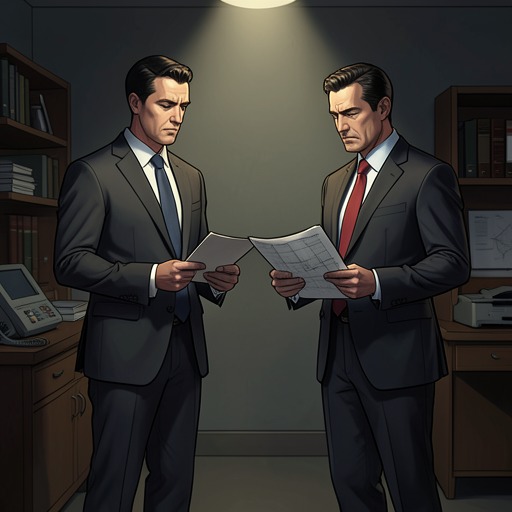
The manner of the decision mattered. Ian had delivered the news in public, near their cars, where he feared Tony might strike him. Tony wanted to hit him but restrained himself. He believed the quiet argument had gone unnoticed, a fact he considered useful because it would keep him from being associated with Ian’s death. The scene exposes how little trust remained: Ian managed the setting to contain Tony’s reaction, while Tony immediately assessed how the exchange might look if he later acted against Ian.
Tony went home with the intention of killing Ian. He remembered that a gun was buried somewhere in his back garden, though he was unsure whether it lay beneath a sycamore or a beech and still needed to locate his spade. He regarded Ian’s decision as one liberty too many, and his resolve hardened as he replayed their argument. Yet his plan was not carried out. Before he could strike at Ian, an unknown assailant killed Tony with a spanner while he was sitting in his kitchen. The abrupt reversal ended the partnership not with the planned confrontation but with Tony’s death.
Investigation and significance
Because Ian had a clear reason to fear Tony and had just delivered damaging news, Elizabeth considered whether Ian might have followed Tony home and killed him first. She reasoned that Ian could have feared Tony’s reaction, tried to placate him in public, then changed course after the meeting. This was an investigative possibility, not a confirmed account of Tony’s murder. Elizabeth also sought to examine the men’s financial relationship, treating the money as a possible route toward motive.
Later, Elizabeth questioned whether investigators had been misled by a file and its twelve-million figure. She asked whether Ian’s whereabouts at the time of Tony’s death were known and whether the timings actually allowed him to have committed the killing. The uncertainty matters: the partnership supplied an intelligible motive for suspicion, but motive alone could not settle who killed Tony. Their business history explains why Ian and Tony were in conflict; it does not, by itself, establish the identity of Tony’s killer.
Ian, too, was later found dead, before he struck the ground after stumbling and falling backwards. His death gives the partnership’s collapse a second fatal endpoint, though the scenes here do not make it the resolution of the Tony investigation. The relationship’s narrative force lies in the way ordinary commercial language—shares, development plans, replacement and cost—gradually reveals a contest over loyalty, control and survival. The same success that had joined the men at Coopers Chase made their separation dangerous, and their shared history became both a motive to investigate and a source of misleading certainty.